
The short answer
An effective cyber communication plan specifies who decides, drafts, approves and receives each message. It provides a channel independent of affected systems, initial factual information, an update schedule and templates for employees, customers, partners and authorities. It always distinguishes operational communication, regulatory obligations and public communication.
- Prepare roles and contact details offline before the incident.
- During the first hour, confirm the known impact without speculating about the cause.
- Separate the technical channel, decision-making channel and public messages.
- Do not confuse service information, GDPR notification and NIS2 notification.
- Test the plan through a simulation and correct timelines, dependencies and contacts.
What the communication plan actually needs to solve
The plan must allow a reliable picture to be shared while information, tools and responsibilities are still unstable. It is not a prewritten press release, but a decision-making mechanism that works during an outage, Microsoft 365 compromise, ransomware, data leak or unavailability of a critical supplier.
Technical incident, cyber incident and data breach
The plan must survive the outage
If the Microsoft 365 tenant, network, IP phone and password manager depend on the same environment, the team may lose messages, contacts and procedures simultaneously. A protected offline copy, limited crisis directory, verified phones and an alternative channel then become operational components, not administrative appendices.
The GVISION page on cybersecurity protection and response presents the technical controls that reduce risk. This guide addresses the human aspect: maintaining consistent communication when the organisation still has only partial facts.
Organise communication during the first hour
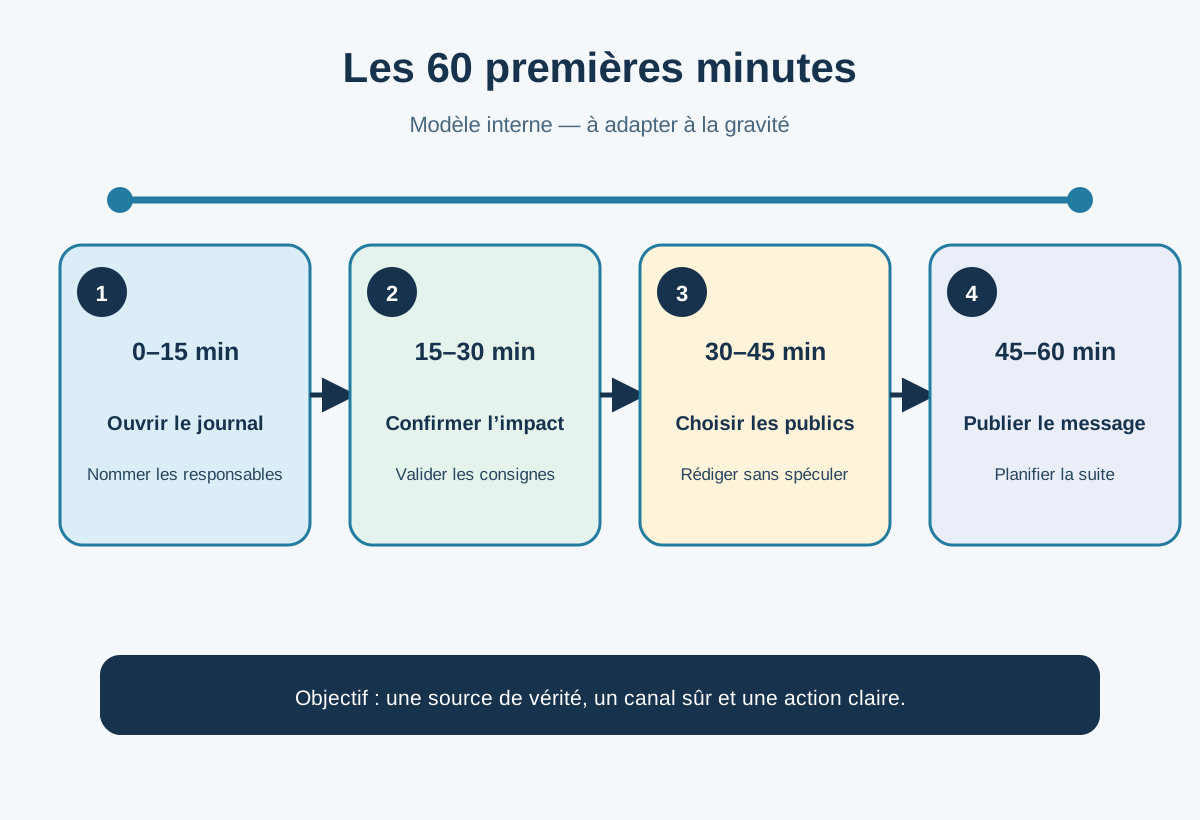
The first hour is for establishing a source of truth, protecting communications and announcing the next update time; it is not for explaining the incident conclusively. The timeline below is an internal model to adapt to the severity, hours and structure of the organisation. These are not legal deadlines.
0 to 15 minutes: open the log and contact decision-makers
Record the detection time, reporter, affected services, actions already taken and uncertainties. Provisionally appoint an incident lead and communications lead. Activate a backup channel if email or Teams integrity is in doubt. Avoid forwarding sensitive screenshots into improvised groups.
15 to 30 minutes: assess the impact that can be communicated
Describe unavailable services, affected groups and requested behaviours. For example: do not restart, do not reconnect to the VPN, do not use an application or keep a device switched on. Have the technical lead approve these instructions; an incorrect instruction can destroy evidence or extend the incident.
30 to 60 minutes: publish the first useful message
The initial message states what is observed, the practical impact, the action expected, the support channel and the next update time. It must not attribute the incident, downplay the risk or announce certain recovery. If no new information is available at the promised time, still publish a status update.
Assign roles and decision-making rights
Credible communication requires an owner for each message and a clearly appointed approver. A large crisis team without decision-making rights creates delays; one person combining technical, legal and communications duties creates blind spots.
Incident lead
They maintain the timeline, decide priorities and confirm the operational account of events. They do not necessarily need to be the most experienced technician: their role is to coordinate, protect decision-making capacity and escalate.
Technical lead
They confirm the impact, containment measures, dependencies and recovery scenarios. They provide facts, not public wording, and explicitly state what remains unknown and what cannot be shared without harming the investigation.
Communications, management, legal and DPO
Communications adapts the language and maintains consistency across channels. Management decides on commitments with commercial or institutional impact. Legal checks contractual obligations and disclosure risks. The DPO assesses the personal data aspect and advises the controller; they do not replace the controller’s decision.
Deputies and thresholds
Every critical role needs a deputy and an independent contact method. The plan can define three levels: a local incident managed by IT, a major incident requiring management and business teams, and a crisis requiring external communication, legal advice and authorities. Thresholds are based on impact, likely duration, data sensitivity and scope, not emotional intensity.
Provide channels that remain available and secure
The main crisis channel must not depend exclusively on the potentially compromised system. An ‘emergency’ mailbox in the same tenant is not a true backup channel if identity, DNS or Microsoft 365 are affected.

Three spaces, three purposes
- Technical channel: evidence, indicators, containment actions and a detailed log.
- Decision-making channel: business impact, decisions, notifications, resources and message approval.
- Information channel: approved messages for employees, customers or partners.
This separation limits leaks, prevents a technical hypothesis being repeated as fact and lets each group receive the right level of detail. Still maintain a shared timeline with the author, time, decision and next action.
Write useful messages without speculating
Each message must cover five points: known situation, impact, expected action, temporary solution and next update. Readers should not have to decode jargon or guess whether they can keep working.
State what is confirmed
Prefer ‘portal access has been unavailable since 09:20’ to ‘we are probably experiencing sophisticated ransomware’. If data confidentiality has not yet been assessed, say so. Distinguish detection time, estimated start and the time of awareness for regulatory purposes.
Give an observable instruction
An instruction such as ‘stay vigilant’ is too vague. State the action: do not open a link, use a backup number, work offline, keep the computer on or suspend data entry. Specify who is concerned and when the instruction will be reassessed.
Avoid absolute promises
Do not say ‘no data has been stolen’ until analysis establishes that. Do not promise a return to normal by noon if the team does not control every dependency. A next communication time is generally more reliable than a resolution time.
Practical formula
We observe X, which affects Y. For now, do Z. Analysis continues. Next update at H via C. This structure suits the first message; it must then be adapted to the audience and facts.
Distinguish crisis communication, GDPR and NIS2
Operational messages never replace a regulatory notification, and not every cyberattack triggers the same obligations. The organisation must separately assess service availability, any personal data breach, whether an NIS2 incident is significant and applicable contractual clauses.
Personal data breach
The Data Protection Authority recalls that a breach must be notified to the competent authority without undue delay and, where possible, within 72 hours of awareness, unless it is unlikely to result in a risk to rights and freedoms. The decision, known facts and analysis must be documented. Communication to affected individuals has a separate threshold and content; it must not be improvised by the IT team.
Significant NIS2 incident
For Belgian entities concerned, the CCB describes staged reporting: an early warning no later than 24 hours after becoming aware of the significant incident, a full notification within 72 hours — with a specific rule for trust service providers — then a final report no later than one month after notification. These deadlines do not turn every outage into an NIS2 incident: entity scope and significance must be checked.
Several clocks may start
A single event may involve the DPA, CCB, a sector regulator, police, insurer and contractually bound customers. Timelines, thresholds and content differ. Maintain a decision sheet with the competent authority, basis, awareness time, owner, deadline and status. Seek legal advice when scope is uncertain.
On IT recovery and continuity plan describes how to prioritise restores. GVISION recommends linking this technical sequence to the communication plan: each service recovery should trigger a verified message, without declaring a system safe before the necessary checks.
Build a recipient matrix
The same incident requires several messages because employees, management, customers and authorities have different decisions to make and different needs for detail.
| Recipient | Main need | Recommended channel | Owner | Avoid |
|---|---|---|---|---|
| Crisis team | Facts, decisions, risks and next actions | Secure decision-making channel | Incident lead | Unlogged discussions |
| Employees | Impact and immediately actionable instructions | Available internal channel + backup | Communications/HR | Jargon and sensitive details |
| Management | Business impact, scenarios, decisions and obligations | Short briefing and decision log | Incident lead | False precision |
| Customers/partners | Affected service, useful measures, next update | Status page, email or dedicated contact | Communications/sales | Unapproved recovery promise |
| Authorities/insurer | Content required by the rule or contract | Official portal or procedure | Legal/DPO/management | Confusing notification and press statement |
| Media/public | Factual position and identifiable spokesperson | Statement and spokesperson | Management/communications | Speculation or premature attribution |
| Best choice according to need | One approved source message, adapted to each audience and distributed through the channel that remains reliable. | |||
Three message templates ready to adapt
Pre-approved templates speed up initial communication, but fields must be filled only with confirmed facts. Keep them offline and specify who may approve them.
1. Initial internal alert
Since [heure], [service] has been [indisponible/perturbé]. The team is analysing the situation. Until further notice, [consigne précise]. Do not use [canal ou application] and report [symptôme] via [canal de secours]. Next update at [heure], even if analysis is ongoing.
2. Customer or partner information
Since [heure], we have been experiencing an incident affecting [service/périmètre]. Our teams have activated the planned response measures. At this stage, the confirmed impact is [fait]. You can [solution temporaire ou action]. We will publish a further update at [heure] via [canal].
3. Service restoration message
The service [nom] has been restored since [heure] and is under enhanced monitoring. [Action utilisateur éventuelle]. Analysis of causes and impacts continues; we will share relevant additional information via [canal]. If you notice [symptôme], contact [point de contact].
These formulations avoid announcing a cause, data theft or definitive resolution before validation. Add sector-specific contractual obligations and have the relevant functions review the templates before an incident.
Adapt the plan to Belgian organisations’ realities
The severity to communicate depends on the service delivered, not just the number of machines affected. The same technical failure can have very different consequences depending on the sector.
School or nonprofit
If email is compromised, the priority is to give staff a reliable channel, prevent fraudulent messages from being acted upon and explain to families how to recognise official communication. The plan must specify who may contact parents, in which languages and through which independent platform.
Medical practice or healthcare facility
An unavailable appointment system or record immediately changes patient reception. The first internal message must describe fallback operations, temporary record keeping and the channel for emergencies. Public information remains minimal to protect data and security, while the DPO assesses a possible breach.
Multi-site business
Each site may experience a different impact. Use local contacts who confirm receipt and execution of instructions. A central dashboard separates “unverified”, “confirmed” and “resolved”. Sales teams receive approved wording so they can respond without creating several versions of the incident.
Administration or public organisation
The plan must include institutional leaders, transparency obligations, emergency procurement procedures and publicly accessible channels. It must also enable publication in the necessary languages without substantive differences. A single source version and checked translations reduce this risk.
Prepare and test the arrangements in ten steps
A plan is operational only when contacts, channels, templates and decision rights are tested under the conditions of a real outage.
- Define the scenarios. Ransomware, identity compromise, cloud unavailability, data leakage and provider outage.
- Classify severity levels. Link each level to a communication trigger and a decision-maker.
- Appoint primary contacts and deputies. Management, incident manager, IT, DPO, legal, HR, communications and business functions.
- Create the crisis contact directory. Work and backup contact details, retained proportionately and securely.
- Separate the channels. Technical work, decisions and information, with an option independent of the main environment.
- Prepare the templates. Alert, situation update, instruction, customer, partner, authority and resolution.
- Map the obligations. NIS2, GDPR, sector, police, insurance and contracts, with owners and procedures.
- Connect communication and recovery. Each technical step must have a message criterion and an approver.
- Simulate real unavailability. Deliberately cut access to the usual tools during the exercise.
- Correct and date. Record gaps, update contacts and schedule the next test.
Mistakes that worsen a crisis
The most common problems stem less from writing style than from untested dependencies and unassigned decisions.
- Keeping everything in Microsoft 365: procedures, passwords and contacts become unavailable simultaneously.
- Creating a large informal group: hypotheses circulate, decisions lose traceability and access persists.
- Waiting for complete certainty: users invent their own explanations and actions.
- Announcing an attack too early: an outage may be misclassified and communication becomes hard to correct.
- Promising a deadline: restoration sometimes depends on a provider, evidence or security checks.
- Copying the same text everywhere: an employee, a customer and an authority have different needs.
- Forgetting languages: an improvised translation can alter an instruction or risk assessment.
- Closing communication when service is restored: follow-up, user actions and lessons learned still need confirming.
Frequently asked questions
Should you communicate before knowing the cause?
Yes, if people need to change their behaviour. Communicate facts, impact and instructions while stating that the cause is still being analysed.
Who should approve the first message?
The plan must decide this in advance. In practice, the incident lead confirms the facts, the communications lead drafts the message and management or its delegate approves it according to severity.
Can Teams be the crisis channel?
Yes, only if its integrity and availability are confirmed. Always provide an independent channel if identity, Microsoft 365 or the network is affected.
Must every cyber incident be notified to the Belgian DPA?
No. GDPR notification concerns a personal data breach likely to result in a risk. The analysis and decision must nevertheless be documented.
Do NIS2 deadlines apply to all organisations?
No. They concern entities within the law’s scope and significant incidents. Check the organisation’s status and applicable criteria.
How often should you publish an update?
The frequency depends on the impact. Set a realistic time and keep it, even if the message simply confirms that analysis continues and instructions remain unchanged.
How often should the plan be tested?
Test it at least whenever the team, provider or architecture changes significantly, and schedule periodic exercises suited to the risk level.
Conclusion: communicate to enable action
Good crisis communication does not seek to reassure at any cost; it gives reliable information to the right audience when a decision is needed. GVISION can connect technical preparation, continuity, roles, backup channels and exercises so the plan remains usable under pressure. To adapt this method to your organisation, contact the GVISION team in Belgium.
To go further, explore our support: Audit your IT security.
Official sources
- CCB — Crisis communication during a cyberattack (new tab)
- CCB — First aid in the event of a cyber incident (new tab)
- Safeonweb@work — Cyberattacks: what should you do? (new tab)
- Belgian DPA — Report and manage a data breach (new tab)
- CCB — The NIS2 law (new tab)
- CCB — How to submit NIS2 notifications (new tab)
Published on . Updated on .
Let’s talk about your project
Want to apply this advice in your organisation? Let's review your needs and next steps together.
Talk to GVISION