
The short answer
Odoo Peppol migration Belgium: to migrate without blocking invoicing, split the project into five phases: inventory the current flow, clean data, configure a test environment, test incoming and outgoing documents, then cut over with a monitoring period. Do not transfer the Peppol registration before validating invoices, credit notes, recipients and support responsibilities.
- A PDF sent by email is not a structured electronic invoice under the Belgian framework.
- The migration must cover outgoing and incoming flows, credit notes and exceptions.
- Master data matters as much as configuration: company number, VAT, country, address, units and taxes.
- The test must prove receipt by the recipient, not just a “sent” status in the ERP.
- A short freeze window, an issue log and a rollback plan prevent improvisation.
Why is an Odoo–Peppol migration sensitive in 2026?
Because the legal channel and business software are now closely connected. Since 1 January 2026, structured electronic invoices have been mandatory for most domestic B2B transactions between Belgian VAT-taxable persons. The official portal explains that these documents are exchanged between applications via Peppol; a PDF invoice remains a readable representation, but is not the required structured flow.
A poorly prepared migration can therefore create several failures at once: a document that cannot be validated, a customer that cannot be found, a Peppol registration still attached to the old provider, an invoice received in the wrong inbox, a duplicate accounting entry or missing delivery evidence. Treating these as a simple email incident slows diagnosis.
The Peppol network is decentralised. The official Belgian site states that delays may occur between sender and recipient providers, their software and internal processing. It does not guarantee instant delivery; when a delay exceeds one working day, the software provider must be able to trace the technical chain. An escalation procedure is therefore a project deliverable, not a detail to decide after an incident.
Odoo documents the creation of structured invoices, Peppol registration and Belgian features in version 19. Choosingan Odoo implementation suited to Belgian processes does not remove the need to validate your data, roles and specific cases. The ERP provides the mechanism; the organisation must define how to use it correctly.
What should you map before changing the configuration?
Follow an invoice from creation to archiving. The inventory describes systems, people and exceptions. A list of applications does not show who approves an invoice, how the accountant retrieves it or where an error gets stuck.
The outgoing flow
Document the invoice's origin: order, contract, timesheet, subscription, delivery, point of sale or manual entry. Then record who checks the customer, VAT rate, purchase reference, due date and bank account. Finally, identify the current channel, when the legal number is assigned, the status considered delivered and the reminder procedure.
The incoming flow
List the inbox or journal receiving purchases, matching rules, approver, cost centres and transfer to the accountant. Correctly configured Peppol receipt can fail operationally if nobody monitors drafts, duplicates, invoices without purchase orders or disputed amounts.
Cases outside the standard path
List credit notes, advances, recurring invoices, self-billing, international sales, public-sector customers, non-taxable customers and corrections after validation. Add essential attachments: service reports, timesheets, minutes or contractual supporting documents. The Belgian requirement covers transactions within the rule; your organisation will often retain several scenarios and must know which to apply.
Invisible dependencies
Check bank exports and e-commerce, CRM, point-of-sale, inventory, payroll, consolidation and reporting connectors. Record automations using an internal identifier, journal name or status. A successful migration can break a dashboard or reminder if these dependencies are not inventoried.
How do you define the right Odoo and Peppol scope?
Deploy the smallest scope covering a complete financial cycle. It must allow a document to be created, sent, received, corrected, posted and retrieved. A pilot limited to the invoice creation screen gives a false sense of readiness.
Decide whether Odoo becomes the main accounting source, an invoicing tool connected to accounting software or a business layer feeding another system. This determines where numbers, taxes, entries, payments and supporting documents live. Avoid two “master” systems for the same object: when both can change a customer or invoice, discrepancies are inevitable.
In a group, treat each legal entity as a separate control unit. Odoo supports multiple companies in one database, with some shared data and some separate data. This flexibility requires correctly assigned permissions, journals, taxes, bank accounts and registrations. Test with a user who should only see one company; a global administrator does not reveal separation problems.
Also define the Peppol provider's role. The Belgian portal describes access points as providers connecting organisations and administrations to the network. If the business is already registered elsewhere, do not assume a second activation automatically replaces the first. Ask for the migration procedure, deregistration responsibilities, effective date and handling of documents in transit.
Which data should you clean before migration?
Clean identities first, then tax rules and finally catalogues. Master data errors recur on every invoice and cost more to correct after cutover.
Companies and contacts
- company number and VAT number in their designated fields, without confusing them with free text;
- legal name, country, billing address and communication language;
- Peppol identifier or information allowing the software to find the participant;
- buyer reference, purchase order number or responsible cost centre where contractually required;
- operational contact for resolving a business rejection, separate from the general invoicing address.
Taxes, products and units
Validate VAT categories, exemptions, fiscal positions, rounding and ledger accounts with the finance owner or accounting firm. Check units and line descriptions used in structured documents. A visually correct invoice can contain inconsistent structured data; the PDF preview is therefore insufficient evidence.
Balances and history
Explicitly choose what is migrated: active records, open invoices, unreconciled payments, full history or read-only archives. For many organisations, importing balances and keeping the old system accessible is less risky than recreating years of entries. The decision must meet legal, accounting and operational needs and be documented with the cut-off date.
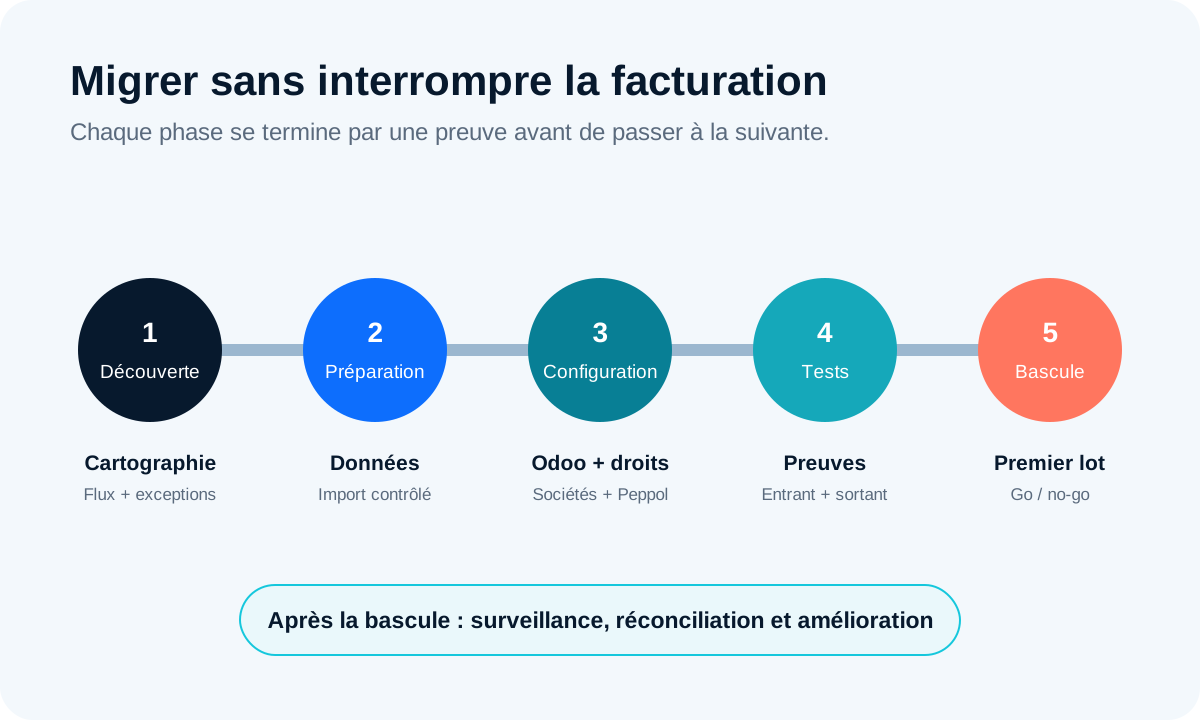
What are the five phases of a migration without interruption?
A reliable cutover moves from evidence to production. Each phase has a verifiable outcome and an exit criterion. Moving to the next step based on an impression increases risk.
| Phase | Objective | Expected evidence | Benefit | Limit / risk |
|---|---|---|---|---|
| 1. Discovery | Understand the current flow and exceptions | Flow map validated by finance, IT and the accountant | Reveals dependencies | May underestimate undocumented practices |
| 2. Preparation | Clean data and rules | Import report without critical issues | Reduces repeated rejections | Requires business decisions |
| 3. Configuration | Configure companies, journals, taxes, permissions and Peppol | Configuration review and separation of roles | Stabilises the technical foundation | Correct configuration does not prove the complete flow |
| 4. Testing | Run incoming and outgoing scenarios | Signed results, receipt evidence and closed issues | Turns assumptions into evidence | An incomplete sample leaves blind spots |
| 5. Cutover | Switch systems and monitor | Reconciliation of the first batch and active support | Limits interruption | Requires availability and quick decisions |
| Best choice according to need | Keep all five phases; adjust only their depth to volume, entity count and integrations. | |||
To connect these steps to ERP, CRM, sales or purchasing management, an overview of business applications integrated by GVISION helps place each piece of data in the right system instead of multiplying synchronisations.
What should the test plan include?
The plan must test anonymised real documents or specially created ones in both directions. A successful test means more than no error message: it checks structured content, delivery, integration and accounting treatment.
Minimum outgoing scenarios
- standard domestic invoice with a usual VAT category;
- multiple lines, discounts or charges, with totals and rounding checked;
- customer requiring a reference or purchase order number;
- credit note linked to an invoice;
- business attachment useful for processing;
- recipient not found or deliberately incorrect data to check error handling and escalation.
Minimum incoming scenarios
Have a partner or designated environment send a test invoice. Check the recipient company, journal, supplier, taxes, duplicate handling, readable document, approval workflow and accounting export. Add an invoice without an order if your organisation accepts it, and a document intended for another group entity to test isolation.
Evidence to retain
For each test, retain the scenario ID, date, company, expected result, observed status, evidence at sender and recipient, issue and decision. Screenshots alone are fragile; also export available logs or technical references without exposing sensitive data.

How do you organise cutover day?
Cutover day must be short, sequenced and reversible while no legal invoice has been sent. Schedule a window with few invoices, inform teams and prohibit master data changes during the final copy.
- Close the current batch. Identify drafts, validated but unsent invoices, documents in transit and unprocessed purchases.
- Export evidence. Retain trial balances, sequences, open-item lists, statuses and settings needed for reconciliation.
- Freeze changes. Set a time after which customers, products, taxes and accounts no longer change in the old system.
- Import the delta. Load only data added or changed since the rehearsal, then check totals.
- Activate according to the procedure. Transfer or activate the Peppol registration at the time agreed with the provider or providers.
- Send a small batch. Start with known recipients available to confirm receipt.
- Decide. The business owner authorises wider rollout only once the criteria are met.
The rollback plan must specify the last point where the old system can resume without duplicate numbers or sends. After legal documents have been issued in the new system, “going back” often becomes an accounting correction rather than a technical restoration. Decision-making authority therefore belongs to a named owner.
What should you monitor during the first weeks?
Monitor volumes, delays, rejections and accounting discrepancies daily at startup. Most migrations do not stabilise with a single test; they stabilise when the first real variants pass through the flow.
- number of invoices created, sent, delivered, rejected and still being processed;
- purchases received by company and supplier, including duplicates;
- time between validation, sending, receipt and posting;
- differences between journals, trial balances, VAT, payments and the accountant’s exports;
- issues by cause: data, setting, integration, network, supplier or procedure;
- user questions that reveal a training need or an ambiguous rule.
Hold a daily fifteen-minute meeting during hypercare, with a single register and an owner for each issue. Close an issue only after reproducing, correcting and retesting it. A temporary manual workaround must have an expiry date; otherwise it becomes a permanent parallel process.
Pay attention to statuses
“Sent” may describe the document leaving the software, while “delivered”, “accepted” or “rejected” refer to other stages depending on the tools. Define your provider’s terms and the level of evidence finance requires. The Belgian website recommends contacting the software provider if a delay exceeds one working day.
Which mistakes most often undermine migration?
The most dangerous errors are decisions that are not made explicit. They lead to two active systems, unclear responsibilities and late corrections.
Activating Peppol too early
Activation before testing can redirect purchases to an environment nobody monitors. Set the effective date, inboxes to check and support contact before activation.
Testing only the PDF
The PDF does not reveal all structured values. Compare the data imported by the recipient: references, taxes, totals, dates, bank account and company.
Importing the entire history unnecessarily
An exhaustive migration increases lead times and discrepancies. Define the operational value of each period. A reliable read-only archive may be preferable to an uncertain reconstruction.
Confusing compliance with a sound process
A technically valid invoice may be rejected by the buyer because of a missing reference or a commercial disagreement. Document how business rejections, credit notes and disputes are handled.
Forgetting access and segregation of duties
Test what the issuer, approver, accountant, administrator and auditor can see. In a multi-company database, verify restrictions with representative accounts.
Odoo Peppol migration Belgium: frequently asked questions
Is a PDF sent by email still sufficient for a Belgian B2B invoice?
For transactions covered by the Belgian requirement since 1 January 2026, the expected document is a structured electronic invoice exchanged via Peppol. A PDF may remain useful as a readable representation or attachment, but it does not replace the structured message. Check exceptions with your tax adviser.
Must all old invoices be migrated to Odoo?
Not necessarily. Determine what continuity requires: balances, open documents, unreconciled payments and useful history. The old system can sometimes remain accessible as a read-only archive. Finance must approve the method, which must comply with retention obligations.
Can Peppol be tested before going live?
Odoo documents a demonstration mode and testing options depending on the configuration. Arrange tests with your integrator and provider to avoid confusing the test environment with production registration. Final evidence must include a controlled end-to-end exchange.
How much time should be allowed for the cutover?
The duration depends on the number of entities, data quality, integrations and tax scenarios. The technical window may be short, but preparation and testing take longer. Do not set the date based on a general estimate: use the results of the cutover rehearsal.
What if an invoice is sent but not received?
Check the exact status, recipient identifier, issuing company and software logs. Ask the recipient to check their system. The official Belgian website states that temporary delays are possible; after more than one working day, contact the software provider to locate the blocked stage.
How do you manage multiple companies in Odoo?
Define companies, permissions, journals, taxes, accounts and responsibilities separately. Test issuing and receiving for each entity, along with isolation using non-administrator users. Shared data must be chosen deliberately rather than inherited without checks.
Who should approve going live?
A business owner, usually finance or management, must accept residual risks after input from IT, the accountant and the integrator. The criterion is not “configuration is complete”, but “critical scenarios have passed and support is ready”.
Odoo Peppol migration Belgium: making cutover a controlled success
Migrating to Odoo is an opportunity to simplify data, eliminate duplicate entry and clarify the invoice–payment cycle. It becomes risky when Peppol registration, testing and responsibilities remain implicit. A five-phase plan, a rehearsal and a controlled first batch help protect continuity while improving the process.
GVISION can scope the flows, configure Odoo, prepare imports and support testing with finance and IT teams. To assess the scope and cutover window, schedule a discussion about your migration project.
Official sources
Published on . Updated on .
Let’s talk about your project
Let’s review your needs and the next steps for your organisation.
Talk to GVISION