The short answer
A good application maintenance SLA defines the scope, covered hours and a criticality matrix, then distinguishes acknowledgement, handling, workaround, restoration and permanent resolution. It also specifies monitoring, security patches, tested backups, deployments, reporting, GDPR responsibilities and exit arrangements. Timelines should reflect real business impact, not a generic promise that cannot be verified.
- An SLA is measurable only if the start, pause and end of each clock are defined.
- A critical incident should be classified by impact and urgency, not the requester's emotion.
- Corrective, preventive, adaptive and enhancement maintenance should be separated in the scope.
- A 'successful' backup is not a demonstrated restore; the contract should address both.
- The SLA, contract, GDPR data processing agreement and continuity plan have different roles.
What does an application maintenance SLA actually do?
The SLA makes service quality observable and governable after deployment to production. It does not prevent bugs or outages. It organises how to detect and assess them, communicate and restore service. Above all, it reduces the grey area between 'hosting works', 'the application responds' and 'the business process is usable'.
An application rarely depends on a single party. Code may be maintained by an agency, infrastructure by a hosting provider, identity by Microsoft Entra, payments by a provider and data by an ERP. An incident visible in the browser may therefore come from a third-party API, certificate, database migration, quota, network rule or functional error. The SLA should describe who coordinates analysis even when the cause is still unknown.
Atlassian documentation summarises SLAs as time targets and rules for acknowledging, updating and resolving tickets. This foundation is useful, but a business application requires more: technical monitoring, releases, security, backups, data, administrative access and exit arrangements need to be linked to the expected service.
Before timelines: map what needs maintaining
A credible timeframe cannot be promised without understanding the architecture, dependencies and impact of downtime. Start with an inventory: code repositories, environments, domains, certificates, secrets, databases, scheduled tasks, storage, identity providers, email services, payment gateways, APIs, libraries and owners.
Then map important journeys. A slow marketing page does not have the same impact as an inaccessible regulatory form, a blocked booking portal or an application assigning service visits. For each journey, note hours of use, affected groups, peak periods, data created and fallback options.
The page Studio hosting, security and maintenance distinguishes monitoring, backups, patches, maintenance and support. This is precisely the separation an SLA should make operational: monitoring is not fixing, backing up is not restoring and responding is not resolving.
Also check maintainability before accepting commitments. A product without documentation, a test environment, code access or a deployment procedure may require a takeover and stabilisation phase. Immediately promising a firm resolution time on an unknown foundation creates risk for both parties.
The 12 clauses that make an SLA usable
The best clauses answer twelve simple questions: what, when, how severe, what timeframe, who monitors, who secures, who deploys, who restores, who protects data, who tests quality, who reports and how to exit.
1. Functional and technical scope
List covered applications, modules, environments, domains and integrations. Distinguish production, staging and development. Specify whether content, user devices, source data, business support or third-party services are included. Attach a versioned architecture annex so new components do not silently enter the scope.
2. Maintenance categories
Separate corrective maintenance, which repairs a defect; preventive maintenance, which reduces risk; adaptive maintenance, which follows browser, API or platform changes; and enhancement maintenance, which adds or modifies functionality. An incident package should not become an unlimited backlog of new features. Define how a request changes category after analysis.
3. Service and on-call hours
State the time zone, Belgian working days, public holidays, channels and exceptions. '24/7' support may mean automated monitoring, on-call cover for critical incidents or a full helpdesk: these are different services. Also specify who can trigger on-call support and how to prevent non-critical requests from mobilising it.
4. The priority matrix
Define each level by impact and urgency: user numbers, essential journey, data loss, security exposure, available alternative and external deadline. A function completely unavailable to two people may be less urgent than a silent error affecting every invoice. Provide an arbitration rule when the customer and maintainer classify differently.
5. Clocks and service targets
Distinguish acknowledgement, start of analysis, update frequency, workaround, restoration and permanent resolution. Explain when time starts, what can pause it — such as waiting for essential information — and which evidence ends it. Permanent resolution sometimes depends on a third-party publisher; a restoration or workaround target is then more controllable.
6. Monitoring and detection
List checks: availability, application errors, latency, scheduled tasks, certificates, capacity, queues, integrations and synthetic transactions. Define thresholds, measurement retention, alert channel and owner. An HTTP test returning 200 does not prove login or payment works; critical journeys deserve checks closer to the real experience.
7. Vulnerabilities and security patches
Specify intelligence sources, assessment, risk-based timelines, exceptions, tests and compensating measures. TheOWASP ASVS 5.0 provides an open foundation for specifying and verifying application security controls, including in contracts. However, the SLA should avoid turning an automated scanner into absolute proof of security.
8. Deployments, changes and rollback
Describe the request, review, tests, approval, production window, observation and rollback. Define who accepts an urgent change and how it is documented afterwards. Measure change-related incidents and rollback success separately.
9. Backups and restoration
Document included data, frequency, retention, encryption, separation, job monitoring and responsibilities. Add data loss and recovery targets where justified without confusing them with support timelines. Require scheduled restoration tests and a report: a green indicator confirms a job, not full service recoverability.
10. Personal data and operational security
When the maintainer processes data for the controller, GDPR Article 28 requires a contract or legal act defining, among other things, the subject, duration, nature, purpose, data types and obligations. Article 32 requires measures appropriate to risk. The SLA should connect these responsibilities to access, logs, incidents, subprocessors, deletion and notification without replacing the data processing agreement.
11. Performance, compatibility and accessibility
Choose a few representative journeys and devices. Define measurement methods rather than an abstract score. Track supported browsers, volumes, execution times and regressions. The W3C WCAG 2.2 sets out testable criteria for making web content and applications more accessible; plan regression testing after significant changes.
12. Reporting, governance and exit arrangements
Define a periodic dashboard: incidents, target compliance, trends, vulnerabilities, backups, releases, capacity, debt and actions. Identify meetings, decision-makers and escalation paths. Exit should provide for data export, code, documentation, transferable secrets, accounts, ticket history, dependencies and transition assistance. Good exit arrangements also improve routine maintenance.
Control table: what needs to be written and proven
Use this table to compare two proposals without reducing the decision to the monthly price or the most dramatic timeframe.
| Clause | What to write | Expected evidence | Risk if absent |
|---|---|---|---|
| Scope | Products, components, environments, exclusions. | Versioned inventory and architecture. | Passing responsibility around. |
| Types of maintenance | Corrective, preventive, adaptive, enhancement. | Rules for classifying requests. | Unpredictable backlog and bill. |
| Coverage | Hours, days, on-call cover, channels. | Tested calendar and contacts. | Availability assumed but not provided. |
| Criticality | Impact, urgency, workaround, security. | Examples from P1 to P4. | Disputed priorities. |
| Timelines | Response, handling, restoration, resolution. | Ticket timestamps. | “Four hours” without meaning. |
| Monitoring | Journeys, thresholds, alerts, retention. | Alert history and testing. | Incident discovered by the customer. |
| Security | Monitoring, triage, patch, exception. | Register and report. | Vulnerability without an owner. |
| Changes | Testing, approval, window, rollback. | Release log. | Irreversible deployments. |
| Backups | Scope, frequency, retention, restoration. | Recovery test report. | Copy present but unusable. |
| GDPR | Roles, access, subcontractors, incidents. | DPA, access register, procedure. | Scattered obligations. |
| Quality | Performance, compatibility, accessibility. | Regression test scenarios. | Gradual degradation. |
| Governance and exit | Reports, escalation, data, code, transfer. | Dashboard and exit plan. | Supplier dependence. |
| Best choice according to need | Choose the proposal linking every commitment to a business journey, owner, measurement method and verifiable evidence. | ||
Build a criticality matrix teams will use
An actionable priority combines impact and urgency, with examples specific to your operations. Avoid defining P1 as a “blocking incident” without explaining for whom, when and with what alternative.
Critical can cover an essential journey unavailable to all users, suspected active exposure, data corruption or inability to meet an immediate deadline. High can concern a significant group without an acceptable workaround. Normal covers a limited or avoidable defect. A planned request is not an incident, even if important.
Add examples: patient portal inaccessible during admissions, service entry blocked before closing, payment unavailable during a campaign or an incorrect export without alert. These help support, business and supplier apply the same rule. Review them after a major incident or process change.
Do not automatically link priority to a promise of final resolution. The provider controls acknowledgement, escalation and restoration efforts better than correction of an external dependency. You can set regular-update and restoration objectives, followed by a root-cause action plan.
The incident lifecycle: seven steps and several clocks
A well-managed incident runs from detection to improvement; it does not end when the screen first returns. The sequence helps place commitments correctly.
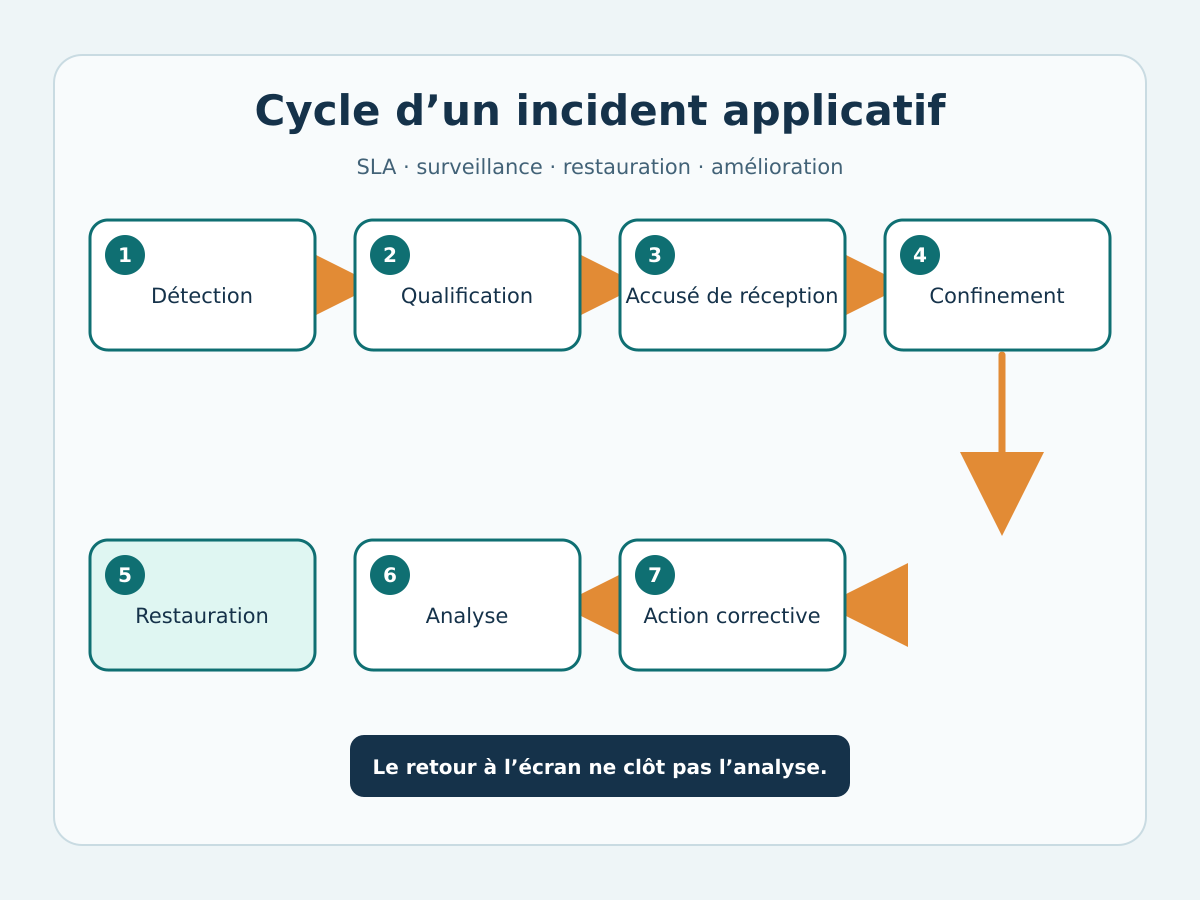
- Detection: automatic alert or user report, with time and symptom.
- Triage: impact, urgency, scope, security and alternative.
- Acknowledgement: confirmation, initial priority and owner.
- Containment or workaround: limit impact without hiding the problem.
- Restoration: return the journey to a usable, verified state.
- Analysis: identify the cause, contributing factors and missing controls.
- Corrective action: correct, test, document and monitor effectiveness.
Tickets must retain priority changes, pauses and communications. Measurement does not serve to create a flattering score: it reveals recurring incidents, fragile dependencies and late detection.
Four Belgian scenarios that change the service level
Organisation size is not enough: hours, seasonality, data and alternatives determine the SLA.
Accounting firm during deadlines
A document portal may be used all year but become critical during tax periods. The SLA can provide increased coverage during announced windows, pre-peak tests and a freeze on non-essential changes. The aim is capacity suited to the actual calendar rather than permanent 24/7 coverage.
Association or non-profit running a campaign
A registration or donation platform has concentrated peaks. Arrangements must cover capacity, payments, transactional emails and campaign support. Outside the period, standard service may suffice. Load tests and payment-provider contacts are more useful than abstract annual availability.
Multi-site group and operational tool
If the application assigns morning visits, a short startup outage has high impact. Plan monitoring before opening, a manual procedure, emergency access and escalation contacts. Fast restoration may take priority over a permanent fix made later in a controlled window.
Administration or healthcare institution
Data responsibilities, accessibility, history and secondary suppliers can matter as much as timing. The DPO, business, security and procurement must validate applicable clauses. Never infer compliance or certification from the SLA alone; require context-appropriate evidence.
For a strategic application, the page Studio web applications and business tools shows how architecture, roles, integrations, documentation and test environments are designed together. Maintenance becomes more predictable when these exist from the design stage.
Negotiate a realistic SLA and manage it over time
Ask first for a measurable method, then adjust coverage and timing to service value. A very short commitment costs more or becomes unverifiable without an on-call organisation, ready access and recoverable architecture.

Give the provider volumes, calendars, journeys and impacts. Ask for assumptions: available team, third parties, monitoring tools, escalation, test environment and dependencies. Run two tabletop scenarios before signing: total unavailability and silent data error. Answers often reveal more than the timing table.
Choose a few indicators: median delay and distribution by priority, update compliance, restoration time, repeated incidents, deployment failures, backup and test success, open vulnerabilities and critical journey availability. An average can hide a long incident; keep major cases visible.
Service credits can have a contractual role, but restore neither data nor trust. Prevention, transparency and learning remain priorities. Have legal clauses reviewed by a qualified adviser; this guide is an operational framework, not legal advice.
Common mistakes that make the SLA decorative
An SLA mainly fails when it uses reassuring words without measurement or clear responsibilities.
- Confusing response and resolution: an automatic acknowledgement does not prove someone is analysing the incident.
- Promising 24/7 without scope: monitoring, on-call duty and user support are mixed together.
- Leaving “critical” subjective: every request becomes urgent and triage loses value.
- Forgetting third parties: nobody coordinates hosting, the software vendor, payments or identity.
- Measuring only infrastructure: the server responds while the business journey fails.
- Counting backups, not restorations: there is no evidence of recoverability.
- Including unlimited enhancements: maintenance becomes an unpredictable project.
- Ignoring accessibility and browsers: a release degrades service for some users without alert.
- Neglecting exit: code, data, secrets and knowledge remain with the supplier.
Frequently asked questions
What is the difference between an SLA and maintenance contract?
The contract sets the commercial and legal framework. The SLA describes service levels, measurements, priorities and operational processes. It may be an annex to the contract.
Does a response time guarantee resolution?
No. The response confirms the issue is being handled. Workaround, restoration and permanent correction need their own definitions and objectives.
Should you require 99.9% availability?
Not automatically. Define the measured journey, period, exclusions and impact. A suitable, verifiable target is better than a generic number.
Are enhancements included in maintenance?
Only if the scope says so. A small backlog may be included, but new features must be assessed, estimated and prioritised separately.
How do you handle a third-party supplier outage?
The SLA must state who opens the case, coordinates, informs and implements a workaround. The third party's correction time cannot always be guaranteed.
Is a successful backup enough?
No. It must be monitored, protected and tested through restoration. Testing confirms that data, configuration and procedure genuinely enable recovery.
Does an SLA prove GDPR compliance?
No. It supports operational responsibilities, but GDPR also requires governance, a legal basis, information, contracts, measures and rights suited to the processing.
Conclusion: make the SLA a management tool
The best SLA can be applied by business teams, IT and the maintainer on a Monday morning and during a serious incident. Start with journeys, make responsibilities visible and require proportionate evidence. GVISION can take over an existing product after analysis, stabilise operations and define commitments matching its criticality. To scope this next step, speak with the Studio team in Belgium.
To go further, explore our support: Our business applications.
Official sources
Published on . Updated on .
Let’s talk about your project
Want to apply this advice in your organisation? Let's review your needs and next steps together.
Talk to GVISION