



FrenchModern Workplace
Website redesign guide · SEO, AI and conversion
Website redesign in 2026: the guide to preserving your SEO and increasing visibility in Google and AI
SEO website redesign: a redesign can make a website faster, clarify the offering and increase conversions. It can also make valuable pages disappear, break links, mix languages or send conflicting signals to Google. Success depends on more than design: it relies on a reliable inventory, a useful architecture, a precise redirect plan, genuinely better content and monitoring after launch.

In brief
- Measure the current website before deciding what should be kept, merged, improved or removed.
- A URL-by-URL matrix is the central document for an SEO migration.
- Every important old page should keep its URL or receive a direct and relevant redirect.
- Google states that established SEO best practices remain relevant for its AI-based search experiences.
- Aim for healthy Core Web Vitals, but do not sacrifice the clarity of the offering for an abstract technical score.
- Monitor indexing, errors, rankings, conversions and revenue for at least 90 days after going live.
Before the redesign: establish a reliable baseline
You cannot protect what you have not measured. Before creating the mock-ups, document the current website’s commercial and organic performance. Export at least the last twelve to sixteen months of Google Search Console data and data from your analytics tool, so that you can distinguish a structural trend from a seasonal effect.
For each page, gather organic clicks and impressions, queries, average position, sessions, conversions, value or leads, inbound links, indexing status, navigation depth and language. Add campaign pages, PDFs, subdomains and old URLs that are still being visited. When available, server logs also show the URLs actually crawled by search engines and errors that are invisible during manual navigation.
Then create four categories: preserve, improve, merge and remove. A page with little traffic is not necessarily useless: it may answer a decisive question for a prospect, receive a quality link or support a topical cluster. Conversely, three nearly identical pages can dilute signals and confuse users.
Also define success metrics. Beyond traffic, measure qualified forms, calls, quote requests, registrations, sales, basket value, time to contact and conversion rate by page type. A redesign that increases visits but hides the service or weakens forms is not a commercial success.
Scoping a redesign project with GVISION starts precisely with these use cases, objectives and technical constraints, so that the interface serves a measurable strategy rather than a simple graphic preference.
The URL-by-URL inventory: the core of the SEO migration
The migration matrix links each old URL to an explicit decision. It prevents improvised redirects on launch night and provides a common reference for the content, development, SEO and marketing teams.
| Scope | Question to resolve | Example decision |
|---|---|---|
| Old URL | Which address is known to Google, users or external websites? | /ancien-service/ |
| Performance | Does it generate traffic, conversions, links or visibility? | 320 clicks/month, 4 leads |
| Action | Keep, improve, merge or remove? | Merge |
| New URL | Which page now addresses the same intent? | /services/nouveau-service/ |
| Redirect | Which status code and direct destination? | 301, with no chain |
| Content transferred | Which information or evidence needs to be retained? | Common mistakes |
| Control | Are the status, canonical, links and indexability correct? | Validated in pre-production |
Avoid redirecting every deleted page to the homepage. A redirect should lead to a useful equivalent. If no equivalent exists and the resource is no longer needed, a consistent 404 or 410 status may be preferable to a misleading destination. Preserve necessary parameters, but eliminate those that create unnecessary duplication.
Identify URLs where case, accents, trailing slashes or protocol vary. Decide on a single convention and apply it everywhere. Ideally, a single redirect should take the user from the old address to the final version; chains increase delays, complicate troubleshooting and can leave old intermediaries in place for years.

Rethink the architecture without losing search intent
A new site structure should simplify the journey while retaining the topics for which the website is already relevant. Start from real needs: understanding an offering, comparing solutions, verifying expertise, obtaining a price, assessing a risk or contacting the company. Assign one main page to each intent rather than several weak pages competing with one another.
For mobile BYOD using MAM, an access policy can require a protected app for Microsoft 365. Microsoft notes that app protection works only with compatible applications and that iOS and Android devices must register with Entra ID for specific controls. For enrolled devices, another policy may require compliance. Scope users, cloud apps, platforms and exceptions deliberately.
Do not mechanically shorten content to achieve a “clean” interface. Retain the answers, examples, evidence, objections and terms that explain the offering. Text can be better structured with headings, lists, tables and callout boxes. A page can be visually clear while still providing useful depth.
Company device
Visibility in Google and AI responses: what really changes
Google states that its established SEO best practices remain relevant for AI-based search features. There is therefore no magic tag that can replace a useful, accessible and trustworthy website. The objective is to make information easy to find, understand, verify and associate with your business.
Write policy and notice. Explain visibility, responsibilities, support, loss, removal, departure and updates.
Belgian scenarios
Structure important information in readable HTML. Tables should have headings, images should have useful alternative text, videos should have a transcript and essential components should not depend on an interaction that cannot be crawled. Schema.org structured data must match the visible content; it clarifies entities and page types but does not guarantee rankings or citations.
Google also recommends high-quality images and videos when they help explain the topic. An original infographic should have a title, alternative text and an explanation on the page. Compress media, specify its dimensions and use modern formats.
Beware of false shortcuts. Google specifically states that its systems do not use the llms.txt file for its AI search features. Such a file may serve other experimental purposes, but it does not replace robots.txt, the XML sitemap, internal linking, canonicals or high-quality information. Invest first in verifiable foundations.
On a multilingual website, assign a separate URL to each version, provide a genuinely useful translation and link equivalent versions with hreflang. Avoid browser-only translation that leaves the same URL or incomplete source HTML. A plugin such as TranslatePress may be suitable if it produces indexable URLs, localised metadata, consistent sitemaps and reciprocal hreflang tags; however, editorial quality must still be validated for each language.
Technical migration: redirects, canonicals, sitemaps and languages
On launch day, Google should be able to quickly understand that the old resource has been replaced by the new one. Permanent server-side redirects are the main signal when URLs change. Google generally recommends keeping them for at least one year; retaining them for longer remains useful for users and external links.
Test every rule using the full URL. Check the HTTP status code, final destination, absence of loops and content match. Update internal links so that they point directly to the new addresses: a redirect is not an excuse to leave the new website navigating through the old one.
Each indexable page should generally have a consistent self-referencing canonical, unless there is a justified strategy. Canonicals, redirects, internal links and sitemaps should all identify the same version. Remove redirected, blocked, error or non-canonical URLs from sitemaps and submit the new sitemaps in Search Console.
For multilingual websites, each page should declare the corresponding FR, NL and EN versions, including itself, using reciprocal tags. Do not associate pages whose content or intent differs simply because they are close to each other in the menu. You may use x-default for a neutral selection page. Language attributes in HTML also improve accessibility.
Avoid changing the domain, CMS, site structure, protocol, design and content all at once if you can sequence the changes. The more variables change together, the harder it becomes to explain a drop. When a domain change is necessary, verify the Search Console properties, retain control of the old domain, migrate the signals and monitor both environments.
Performance, accessibility and security: build quality in from the outset
A fast but unusable page is not a good page; a beautiful but slow and unstable page also loses visitors. Google recommends, at the 75th percentile of visits, an LCP of 2.5 seconds or less, an INP below 200 milliseconds and a CLS below 0.1. Measure real-world data when available, not just a laboratory test.
Company device
Accessibility should be built into the components: keyboard navigation, visible focus, sufficient contrast, form labels, understandable error messages, logical headings and a reduced-motion preference. Test with zoom, keyboard and a screen reader, not just an automated tool. These choices broaden the audience and often make content easier to interpret.
From a security perspective, enforce HTTPS, keep the CMS and extensions up to date, minimise privileges, protect administration with MFA, validate inputs, back up data and test restoration. Headers such as Content-Security-Policy, HSTS, X-Content-Type-Options and an appropriate referrer policy can reduce certain risks when correctly configured. Do not copy a security policy without testing its impact on the website.
Going live does not end these responsibilities. A contract for maintenance and hosting with GVISION can cover monitoring, updates, backups, security and performance, with clear responsibilities after the project.
SEO website redesign: launch checklist
Carry out a pre-production rehearsal, then check everything again in production. The pre-production environment should be protected from indexing and external users, while remaining accessible to authorised testing tools. Do not accidentally copy a noindex or blocking rule at launch.
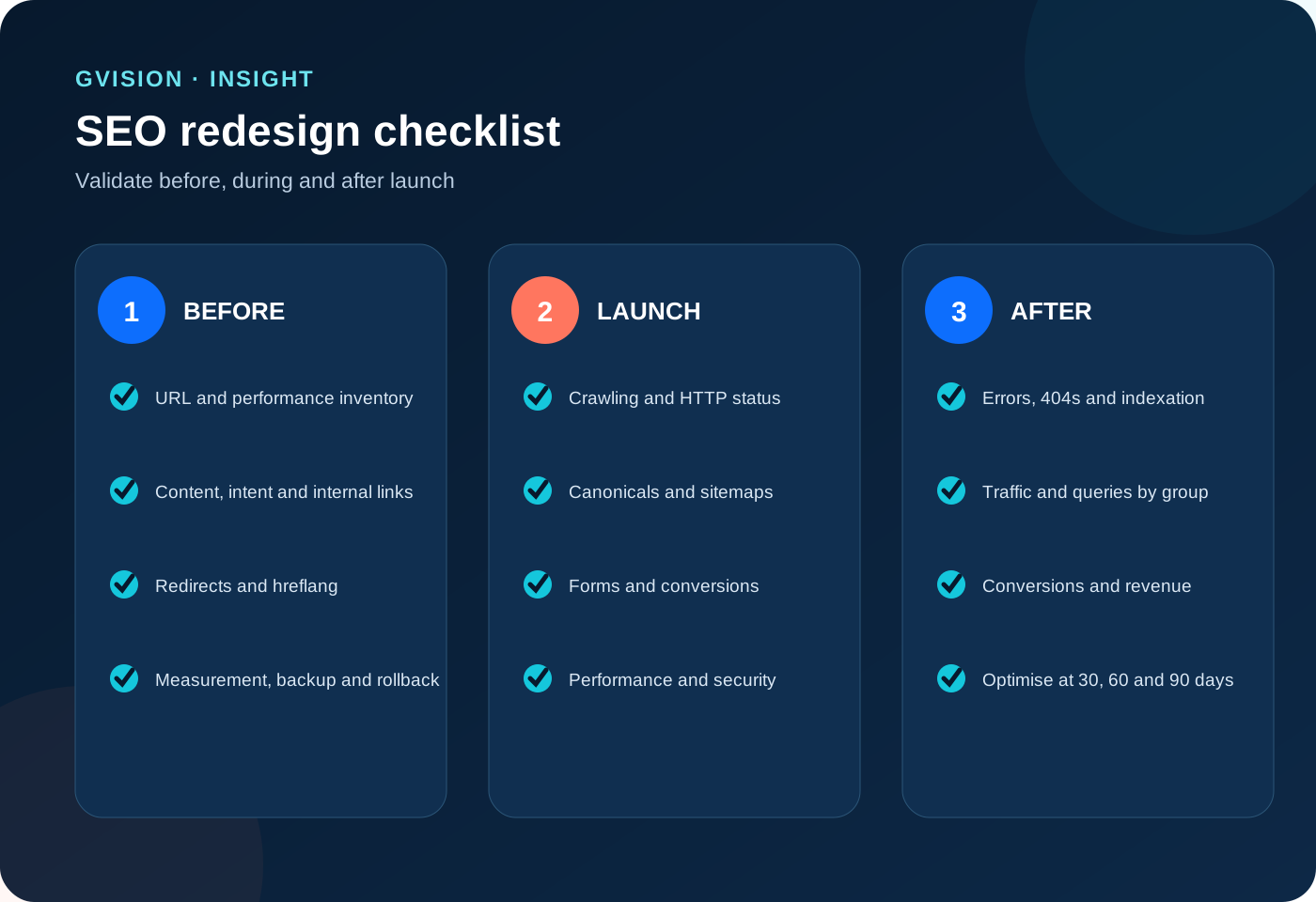
- Exploration: all priority pages return 200, with no blocking or
noindexunintentional. - Redirects: old URLs tested, relevant destinations, no loops or unnecessary chains.
- Canonicals: consistent with the final URLs, protocol and trailing-slash convention selected.
- Multilingual: reciprocal hreflang tags, HTML language, localised content and metadata.
- Content: Write policy and notice. Explain visibility, responsibilities, support, loss, removal, departure and updates.
- Media: dimensions, compression, formats, alt text and appropriate loading.
- Structured data: valid and consistent with the visible content.
- Measurement: analytics, consent, events and conversions tested end to end.
- Technical: sitemap, robots.txt, 404 pages, forms, emails, cache and security validated.
- Operations: backup, rollback, owners and incident channel ready.
After launch: monitor at 30, 60 and 90 days
A temporary variation is possible, but a persistent drop must be explained page by page. From launch onwards, crawl the public website, test a sample of every redirect rule and inspect priority pages in Search Console. Monitor server errors, 404s, excluded pages, Google-selected canonicals and sitemaps.
Days 1 to 30: detect migration errors
Write policy and notice. Explain visibility, responsibilities, support, loss, removal, departure and updates.
Days 31 to 60: analyse content and intent gaps
Four access and management models with Microsoft Intune
Days 61 to 90: optimise conversion and growth
Once indexing and signals have stabilised, improve calls to action, forms, evidence and user journeys. Test high-traffic pages with low conversion rates. Then develop topical clusters that demonstrate demand: guides, comparisons, customer cases and useful tools, linked to a clear service page.
Frequently asked questions
Does a redesign always reduce search rankings?
Limitation
Should all old URLs be retained?
Keep useful URLs if doing so does not harm the architecture. If they change, redirect important old addresses to the closest equivalent. An obsolete page with no relevant replacement can return a 404 or 410.
How long should 301 redirects be kept?
Google generally recommends keeping them for at least one year when moving a website. Keeping them for longer helps visitors, bookmarks and external links that still use the old URLs.
Does the llms.txt file improve visibility in Google AI Overviews?
Google states that its AI search systems do not use llms.txt. The priorities remain high-quality content, indexability, internal linking, consistent structured data and other SEO fundamentals.
Can a website be translated with TranslatePress without harming SEO?
Yes, provided each language has indexable URLs, localised metadata, consistent sitemaps and reciprocal hreflang tags. The translation should be reviewed and adapted to the searches and expectations of the local market.
When should Core Web Vitals be measured?
Measure them in pre-production to identify issues early, immediately after launch and then using real-world data. The environment, marketing scripts and visitor behaviour can change the results.
Should the domain be changed during a redesign?
Only if the business rationale justifies it. Changing the domain adds risk and work. If necessary, retain the old domain, map all URLs, configure the Search Console properties and monitor both versions.